
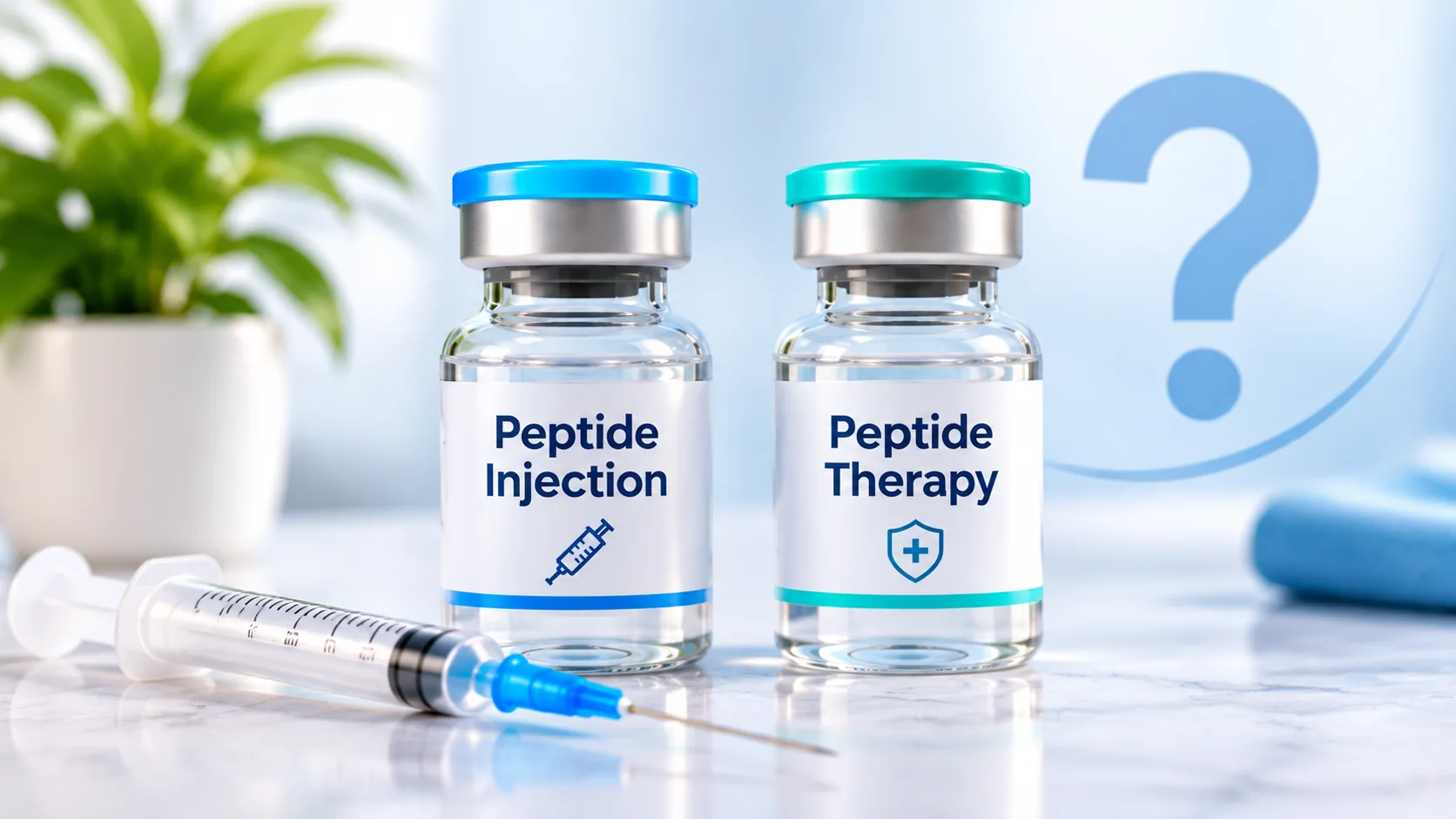
Peptide injection vs peptide therapy: The main difference is that a peptide injection describes how a medicine is delivered, while peptide therapy describes the treatment itself.
The two terms are often used interchangeably, especially in discussions about weight management and wellness. But they are not identical, and understanding the distinction can help patients ask better questions about a proposed treatment.
For readers in Qatar, there is another important consideration: the regulatory status of the specific medicine. Not every product advertised as a peptide treatment is authorized for medical use.
What Are Peptides?
Peptides are chains of amino acids, the building blocks of proteins. Many naturally occurring peptides help regulate functions such as appetite, blood glucose, and hormone signaling.
Some medicines use peptides or act on peptide-related pathways. These include established treatments for certain medical conditions.
However, the word peptide is also used to market experimental substances for recovery, anti-aging, and performance enhancement. Being described as a peptide does not establish that a product is safe, effective, or approved for human use.
What Is a Peptide Injection?
A peptide injection is a method of administering a medicine containing a peptide or peptide-related active ingredient.
Depending on the product, the medicine may be injected under the skin or administered by another approved route.
Examples of peptide-based or peptide-related injectable medicines include:
- Insulin: Used in the management of diabetes.
- Semaglutide: A GLP-1 receptor agonist used in certain prescription medicines.
- Tirzepatide: A medicine that acts on GIP and GLP-1 receptors and has specific approved medical indications in some countries.
These examples explain the category; they do not establish that every formulation, brand, or indication is authorized in Qatar.
An injection is simply the delivery method. It does not, by itself, tell you whether a medicine is suitable for a patient.
What Is Peptide Therapy?
Peptide therapy is a broad term for treatment involving peptides or peptide-related medicines.
In evidence-based medical care, treatment is selected for a specific clinical reason. A healthcare professional considers the patient’s diagnosis, medical history, contraindications, expected benefits, and potential risks.
The term does not necessarily mean an injection. Some peptide-related medicines have approved oral formulations.
It is also important to recognize that peptide therapy is not a single standardized treatment. Two services advertised under this name may involve entirely different substances, purposes, and levels of scientific evidence.
Patients should therefore ask which exact medicine is being proposed rather than relying on the general label.
Peptide Injection vs Peptide Therapy: Key Differences
| Feature | Peptide Injection | Peptide Therapy |
|---|---|---|
| Meaning | A method of delivering a medicine | A broader term describing treatment |
| Main question | How is the medicine administered? | Why is the medicine being used? |
| Administration | Involves an injection | May involve injections or other formulations |
| Medical purpose | Depends on the medicine being injected | Depends on the condition and treatment plan |
| Safety assessment | Requires product-specific precautions | Requires evaluation of the overall treatment |
| Regulatory status | The injectable product must meet applicable requirements | The medicine and associated healthcare services must meet applicable requirements |
In simple terms: An injection is a way to give a medicine. Therapy is the treatment being provided.
For example, a patient might receive an injectable prescription medicine as part of a broader treatment plan that includes medical assessment, monitoring, and follow-up.
What Are Peptide-Based Medicines Used For?
Peptide-based and peptide-related medicines have several established medical applications. Their uses depend on the specific product and its approved indications.
Diabetes Management
Insulin is a well-established example of a peptide hormone used as a medicine.
Other medicines acting on hormone-related pathways may also be prescribed for eligible patients with type 2 diabetes.
The choice of treatment depends on the patient’s condition and medical needs.
Weight Management
Certain prescription medicines acting on GLP-1 or related pathways are used for weight management in patients who meet defined clinical criteria.
These medicines are not appropriate for everyone. Their benefits, adverse effects, contraindications, and approved uses vary by product.
Approval in one country does not automatically establish approval in Qatar.
Other Medical Conditions
Peptide-related medicines are also used in selected hormonal and other medical conditions.
This does not mean that all products marketed as peptide therapy have proven medical benefits. Each substance must be assessed individually.
What About Peptides Marketed for Recovery or Anti-Aging?
Online advertisements sometimes describe peptides as treatments for faster recovery, tissue repair, improved performance, or reversing aging.
Such claims need careful examination.
A laboratory finding, animal study, or early-stage clinical trial does not establish that a product is safe and effective for routine human treatment.
Patients should distinguish between an appropriately authorized medicine with supporting clinical evidence and an investigational substance being marketed beyond the available evidence.
Are Peptide Injections and Peptide Therapy Legal in Qatar?
The answer depends on the exact product and its regulatory authorization.
In August 2026, Qatar’s Ministry of Public Health (MoPH), through its Pharmacy and Drug Control Department, announced restrictions on unlicensed peptide preparations.
The reported directive prohibits activities involving peptide preparations that have not received the required licensing, including importation, trading, prescribing, dispensing, administration, use, advertising, and promotion.
Examples identified in the announcement included BPC-157, retatrutide, and MOTS-c.
The restrictions also address preparations marketed as being for research purposes when they are intended, used, or promoted for human use without the required authorization.
This should not be interpreted as a blanket prohibition on every established peptide-based prescription medicine. The regulatory status of each product must be checked individually.
Patients should confirm the status of a specific medicine with the relevant Qatar authorities and use appropriately licensed healthcare channels.
Further reading: Are Peptides Legal in Qatar?
What Are the Possible Side Effects of Peptide Injections?
Side effects vary considerably between medicines. There is no single safety profile that applies to every peptide injection.
Depending on the product, possible concerns may include:
- Pain, redness, or irritation at the injection site
- Nausea or digestive symptoms
- Allergic reactions
- Medicine-specific contraindications or interactions
- Problems caused by incorrect dosing or administration
Some medicines have additional serious warnings that are not captured by this general list.
Unlicensed or improperly sourced injectable products may also raise concerns about identity, purity, sterility, and dose accuracy.
Patients should review the official product information and discuss relevant risks with a qualified healthcare professional before starting a prescribed treatment.
Further reading: Peptide Therapy Side Effects: What Patients Should Know
Five Questions Patients in Qatar Should Ask
Before considering a peptide-based treatment, ask these five questions.
1. What is the exact medicine?
Request the generic name, formulation, and intended medical use. A broad label such as peptide injection is not enough to assess a treatment.
2. Is it authorized for the intended use in Qatar?
Check the product’s current regulatory status through the appropriate Qatar authorities. Do not rely solely on international marketing claims.
3. Why is this treatment being recommended?
A healthcare professional should be able to explain the clinical indication, expected benefits, alternatives, and limitations.
4. What are the risks?
Ask about contraindications, adverse effects, interactions, and any monitoring required.
5. Who is responsible for prescribing and supplying it?
Confirm that the professionals, facilities, and supply channels involved have the necessary authorization.
These questions are especially relevant when a product is advertised through social media or offered through an overseas provider.
Understanding Peptide Therapy in Qatar
People researching peptide injections in Doha or elsewhere in Qatar may encounter both established prescription medicines and experimental products advertised under similar names.
The most useful starting point is to identify the specific substance, understand its evidence base, and verify its regulatory status.
For additional educational information and Qatar-specific considerations, visit our Peptide Therapy in Qatar page.
This link is provided for general information and does not establish that any particular medicine or service is authorized, available, or suitable for use in Qatar.
Frequently Asked Questions
Is peptide therapy the same as peptide injections?
No. A peptide injection is a method of administering a medicine. Peptide therapy is a broader description of treatment involving peptides or peptide-related medicines.
Are all peptide treatments injectable?
No. Some peptide-related medicines have oral formulations. The available route depends on the specific product and its approved instructions.
Are peptide injections safe?
Safety depends on the exact medicine, its clinical use, the patient’s health, product quality, and appropriate medical supervision. No peptide injection should be assumed safe solely because it is described as a peptide.
Can I buy peptide injections online in Qatar?
An online listing does not establish that a product or seller is authorized. Qatar restricts unlicensed peptide preparations, including their sale and promotion. Patients should verify the medicine and supply channel before considering any purchase.
Do peptide injections require a prescription?
Many established injectable peptide-related medicines are prescription-only. Requirements depend on the particular product and applicable Qatar regulations.
Is an experimental peptide the same as an approved medicine?
No. An experimental substance may still be undergoing research or may lack the authorization required for routine medical use. Its advertised benefits should not be treated as established clinical outcomes.
Final Thoughts
The difference between peptide injections and peptide therapy is straightforward: one describes the method of administration; the other describes the treatment.
The more important question is whether the specific medicine has a sound medical purpose, adequate supporting evidence, and the required regulatory authorization.
For patients in Qatar, checking these details is essential before considering any peptide-based treatment.
References
- Qatar Ministry of Public Health announcement reported by The Peninsula, 27 August 2026
- Qatar Government — Registration of a Pharmaceutical Product
- US National Institute of Diabetes and Digestive and Kidney Diseases — Prescription Medications to Treat Overweight & Obesity
- US FDA — Dosing Errors Associated With Compounded Injectable Semaglutide
Medical disclaimer: This article provides general educational information and is not a substitute for personalized medical advice. Drug approvals, regulatory restrictions, and prescribing requirements can change. Patients should confirm current requirements with the appropriate authorities and qualified healthcare professionals.